Your child is ready for more.
An independent school for Kindergarten through 8th Grade in Berkeley, California, founded in 1969 and devoted, without apology, to the life of the mind.
Why The Academy?
‘Omnia praeclara tam difficilia quam rara sunt.’
—Baruch Spinoza, Ethica (1677)
Spinoza’s sentence is our school motto. We are a school of high expectations, and we say so plainly. For more than fifty years we have asked children to read demanding books, to stay with problems that do not yield at once, and to treat one another with care while they do it. We believe that learning to think well and learning to live well are a single education.
-
‘Fall seven times, stand up eight.’
—Japanese proverb
We give children hard things to do. A six-year-old sounds out a sentence that resists them; a twelve-year-old works through a line of Latin. A child who has struggled with something difficult and come out the other side discovers what their own mind can do, and finds that discovery a pleasure. When a student falls, a teacher who knows precisely where they stumbled is beside them, and they try again. Falling is part of it.
-
Eighty-one percent of our faculty hold advanced degrees, and nearly all of them are studying something still: a language, a period of history, a better way to teach fractions. That habit shapes every lesson. When a child asks ‘Why?’, the teacher is glad, and the lesson follows the question. Education is relational, and a child learns to love learning from an adult who plainly loves it.
-
‘To know what you know and what you do not know, that is true knowledge,’-Confucius
Confucius taught, and our teachers take him at his word: they ask far more than they tell. A student here learns to build a case from evidence, to hear the strongest objection to it, and to change their mind when the evidence requires it. What a child comes to believe is their own. Our part is to see that they got there by thinking.
-
Ten to twelve students in Kindergarten through 2nd Grade, twelve to fourteen in 3rd through 5th, sixteen in the middle school. In a class of that size every child is known and none is overlooked. A teacher knows how each one reads, reasons and falters, and can ask of each exactly what they are ready to attempt next.
-
‘One child, one teacher, one book and one pen can change the world.’
—Malala Yousafzai, address to the United Nations, 12 July 2013
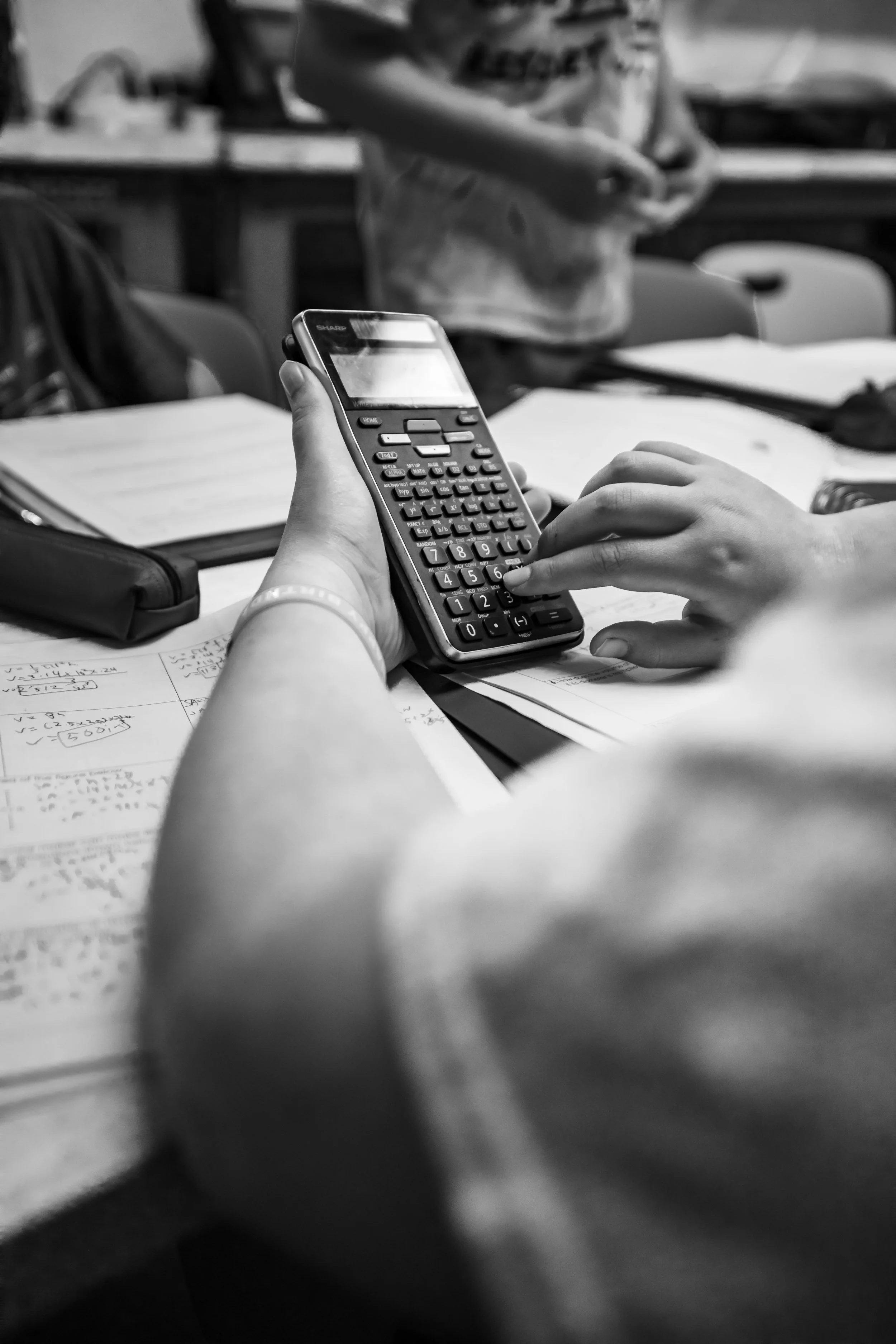
The oldest tools for training attention are a book, a pencil, and another person to talk to, and in our youngest grades those are nearly all you will see. A child learns to read, to share, and to stay with a hard problem by doing those things slowly, in company. As students grow older we bring in other tools and teach them to use them well. Before any screen appears we ask the same question: what is this for?
Come see a classroom in motion.
Come and stand in a classroom. A school is best understood from inside a lesson, so we invite you to visit on a weekday morning and listen to the children think. Tours are by appointment.